|
|
|
Amigos w/ Common Interests
|
|
|
|
|
|
|
|
|
|
|
|
|
|
|
|
|
|
<<
View Prev Image
|
|
|
|
View Next Image >>
|
|
|
|
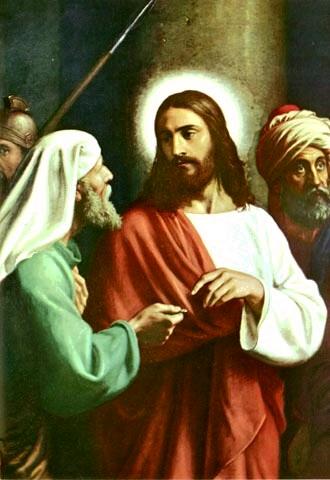
"Render unto Caesar ..." (painting by Anton Dorph)
This Sunday in our Church
29th Sunday in Ordinary Time
Liturgy of the Word:
First Reading: Isaiah 45:1, 4-6
Responsorial Psalm: Psalms 96:1, 3, 4-5, 7-8, 9-10
Second Reading: First Thessalonians 1:1-5
Gospel
Mt 22:15-21
The Pharisees went off
and plotted how they might entrap Jesus in speech.
They sent their disciples to him, with the Herodians, saying,
"Teacher, we know that you are a truthful man
and that you teach the way of God in accordance with the truth.
And you are not concerned with anyone's opinion,
for you do not regard a person's status.
Tell us, then, what is your opinion:
Is it lawful to pay the census tax to Caesar or not?"
Knowing their malice, Jesus said,
"Why are you testing me, you hypocrites?
Show me the coin that pays the census tax."
Then they handed him the Roman coin.
He said to them,
"Whose image is this and whose inscription?"
They replied, "Caesar's."
At that he said to them,
"Then repay to Caesar what belongs to Caesar
and to God what belongs to God."
Homily by Fr. Larry Gilllick, SJ
We are invited by the readings of this liturgy to reflect upon, at which altar do we worship. In the history of the human race there have been many altars to many gods and goddesses. Some of these holy places are of humans forming likenesses of superhuman beings. Some, like mountains and rivers, are of nature reflecting force and supremacy.
"The Book of Consolation" which comprises the fifteen chapters, forty to fifty-five of the Prophet Isaiah, deal with the people of Israel being in the Babylonian captivity. They are exiled from their homeland and long for release. These many oracles, poems, songs and predictions are meant to keep hope alive in the hearts of the people. Early in the Book, God has called a foreign king, Cyrus, who does not know exactly how he has been called by God. The prophet proclaims that God has called this Cyrus, who is so powerful that kings run away from him, to be the victor over Israel’s captors.
We hear the second section of God’s call to Cyrus begun a few chapters earlier. God affirms that Cyrus, a foreign military leader, has the title of the "anointed". It may sound as if God is boasting like a professional wrestler, but instead God is protesting divine fidelity to the Jewish nation who lies in captivity. Help is on the way and it is God Who is behind Cyrus’s power and victories.
The Gospel story is familiar and the final line is often quoted to various purposes. The Pharisees have been getting hit in their collective noses by the recent parables which Jesus has directed toward them. They want to trap Him and so do something rather strange for them.
The Herodians are a separate Jewish group who cling to the Pentateuch as containing nothing about the resurrection of the body after death. Even more importantly for this Gospel text, the Herodians accepted the authority of the Romans and their allegiance to Caesar. The Pharisees wishing to get Jesus in conflict with the Romans, allied themselves with supporters of the Roman domination.
"Repay to Caesar" is the way Jesus avoids entrapment with the Romans which would be reported by the Herodians. Repaying to God what belongs to God is Jesus’s call to the interior surrender to which all of God's people are called. God, the "Dominus", is greater than Caesar and God’s empire more extensive.
Caesar’s image was on the coin of the realm. As we know it was a powerful and extensive kingdom, but temporal. We struggle to live with the belief that God’s image is upon everything and everyone. We are made in that image while we wear our human smudge. It was easy for the Herodians and Pharisees to see Caesar’s image. It takes some reflection to pick up God’s image upon us and others. That image may pop up clearly on the faces of little babies and tall mountains. Our human senses have a built-in filter which is reluctant to repay God for what belongs to God.
"Internal possessiveness" is the basis of spirituality and the following of Jesus. It has several aspects.
We are invited to receive interiorly God’s image and God’s creating of us. We possess God’s dwelling within us. This allows us to be more grateful for the particular and peculiar person each of us is.
"Interior possessiveness" allows us to be more generous. What we have is a wonder-filled gift which has many auxiliary gifts that express reception in their distribution. Instead of greed, instead of having to possess for ones identity, generosity and service are the coins of the realm.
Repaying God with that which belongs to God is called the Christian life. Jesus as King of that realm lived His interior-possession by pouring Himself into each of His life’s gestures. He lived externally what He was internally.
(last paragraph is in comments) |
|
|
|
|
|
| |
|
|
|
|
|
My Favorites
|

 tomswift46
Apr 06, 2008
Tenafly, NJ
|

 siamakjafari
Apr 01, 2008
tehran, Iran, Islamic Republic Of
|

shakeh

Mar 31, 2008
tehran, Iran, Islamic Republic Of
|

tomswift46
Mar 31, 2008
Tenafly, NJ
|
More Favorites >>
|
|