|
|
|
Amigos w/ Common Interests
|
|
|
|
|
|
|
|
|
|
|
|
|
|
|
|
|
|
<<
View Prev Image
|
|
|
|
View Next Image >>
|
|
|
|
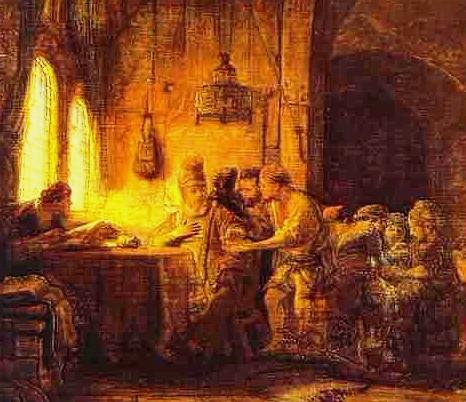
The Laborers from the Vineyard
Rembrandt (detail)
Today in Our Church
25th Sunday of Ordinary Time
Gospel
Mt 20:1-16a
Jesus told his disciples this parable:
"The kingdom of heaven is like a landowner
who went out at dawn to hire laborers for his vineyard.
After agreeing with them for the usual daily wage,
he sent them into his vineyard.
Going out about nine o’clock,
the landowner saw others standing idle in the marketplace,
and he said to them, ‘You too go into my vineyard,
and I will give you what is just.’
So they went off.
And he went out again around noon,
and around three o’clock, and did likewise.
Going out about five o’clock,
the landowner found others standing around, and said to them,
‘Why do you stand here idle all day?’
They answered, ‘Because no one has hired us.’
He said to them, ‘You too go into my vineyard.’
When it was evening the owner of the vineyard said to his foreman,
‘Summon the laborers and give them their pay,
beginning with the last and ending with the first.’
When those who had started about five o’clock came,
each received the usual daily wage.
So when the first came, they thought that they would receive more,
but each of them also got the usual wage.
And on receiving it they grumbled against the landowner, saying,
‘These last ones worked only one hour,
and you have made them equal to us,
who bore the day’s burden and the heat.’
He said to one of them in reply,
‘My friend, I am not cheating you.
Did you not agree with me for the usual daily wage?
Take what is yours and go.
What if I wish to give this last one the same as you?
Or am I not free to do as I wish with my own money?
Are you envious because I am generous?’
Thus, the last will be first, and the first will be last."
+ + + + + + + + + + + + + + + + + + + + +
Homily
by Father Raniero Cantalamessa, OFM Cap., the preacher of the Pontifical Household
The parable of the laborers sent to work in the vineyard at different hours, all of whom receive the same pay of a denarius, has always created a difficulty for readers of the Gospel. Is the proprietor's way of acting acceptable? Does it not violate the principle of the just compensation? Labor unions would all rebel if someone acted like that householder.
The difficulty stems from a mistake. The problem of the compensation is considered in the abstract, or rather in reference to the eternal. So regarded, the topic would in fact contradict the principle according to which God "will render to every man according to his works" (Romans 2:6).
Jesus is referring here to a concrete situation. The only 'denarius' that is given to all is the kingdom of God, which Jesus has brought on earth; it is the possibility to participate in the messianic salvation. The parable begins: "The kingdom of heaven is like a householder who went out early in the morning." The Kingdom of heaven, therefore, is the main theme and background of the parable.
The problem is, once again, that of the posture of Jews and pagans, or of the just and sinners, in face of the salvation proclaimed by Jesus. Although it was only when hearing Jesus's preaching that the pagans (sinners, publicans, prostitutes, etc.) decided for God, while before they were far off ("idle"). Because of this will they will not occupy a second class place in the kingdom. They will also sit at the same table as all others and enjoy the fullness of the messianic goods.
More than that, given that pagans show themselves more disposed to accept the Gospel than the so-called just (Pharisees and scribes), we see here what Jesus says at the conclusion of the parable:
"The last will be first, and the first last."
Once the kingdom is known, that is, once the faith is embraced, then there certainly is room for differences. The fate is not identical of the one who serves God all his life, making his talents yield the most, and the one who gives God the leftovers of his life, with a confession to make amends, in a certain sense, at the last moment.
Having clarified this key point, it is legitimate to bring to light the other teachings of the parable. One is that God calls everyone at all hours. There is a universal call to the Lord's vineyard! It is, in brief, the problem of the call more than that of the recompense.
This is the way John Paul II used this parable in exhortation on the vocation and mission of the laity in the Church and the world:
"The lay faithful belong to that people of God represented by the laborers of the vineyard ... 'You go into my vineyard too'" (Nos. 1-2). . .
Another teaching can be drawn from the parable. The householder knew that the laborers of the last hour had the same needs as the others; they also had their children to feed, as did those of the first hour. Giving all the same pay, the householder shows that he doesn't consider merit as much as need.
continues below |
|
|
|
|
|
| |
|
|
|
|
|
My Favorites
|

 tomswift46
Apr 06, 2008
Tenafly, NJ
|

 siamakjafari
Apr 01, 2008
tehran, Iran, Islamic Republic Of
|

shakeh

Mar 31, 2008
tehran, Iran, Islamic Republic Of
|

tomswift46
Mar 31, 2008
Tenafly, NJ
|
More Favorites >>
|
|